

2026 THEMIS SCIENCE NUGGETS
Observations of High-Resolution Two-Dimensional Ionospheric Flow Dynamics Associated with Poleward Boundary Intensifications
Katherine Davidson
Boston University
Introduction
Poleward boundary intensifications (PBIs) are one of the most common auroral disturbances and have been linked to reconnection points in the magnetotail known as X-lines. These X-lines are critical to study because they represent an energy transfer point between the solar wind and the near-Earth magnetosphere, which is an important step in space weather processes. In addition to the link between ionospheric PBIs and magnetospheric X-lines, ionospheric polar cap flow channels are also linked to magnetospheric lobe flows. Polar cap flow bursts are commonly observed with PBIs, which can be interpreted as magnetospheric inflow channels triggering reconnection.
This connection, however, has only been observed in one-dimensional line-of-sight (LOS) radar data. Using a new application of spherical elementary current systems (SECS) to Super Dual Auroral Radar Network (SuperDARN) LOS observations, we can now investigate the two-dimensional flow characteristics associated with PBIs. Additionally, we can use the relationship between two-dimensional flows and PBIs to infer X-line dynamics, such as X-line spreading and multiple X-lines. In the present study, we use coordinated THEMIS All-Sky Imager (ASI) and SuperDARN SECS vectors to show that ionospheric flow channels play a determining role in PBI morphology, including spatial extent, number, and propagation. These results suggest that inflow properties strongly influence X-line dynamics.
|
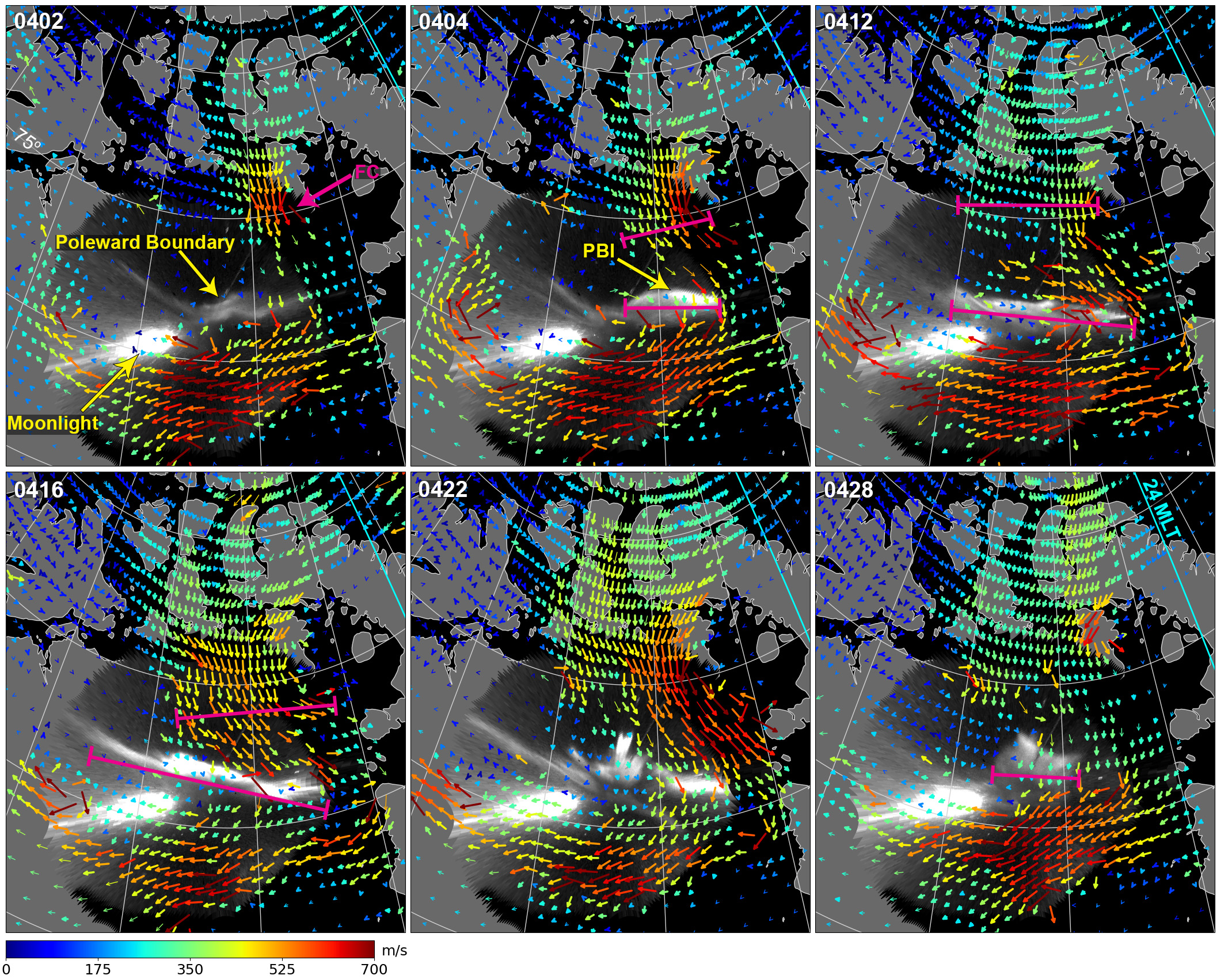
| Figure 1. Snapshots of RANK ASI (gray-scale) images with SuperDARN SECS vectors (colored arrows) overlaid showing the time sequence of the PBI event on 16 February 2024. Heavier arrows indicate locations with echo returns while lighter arrows indicate no echo returns. Midnight MLT is a cyan line. Magnetic latitude and longitude lines are drawn as light gray lines, and are separated by 5° and 15° (1 MLT), respectively. Magenta bounding lines show approximations of the spatial extent of the flow channel and PBI. |
Results
Figure 1 presents selected maps of SuperDARN and ASI observations during a quiet-time PBI event. The event proceeds as follows: an intense equatorward polar cap flow channel appears ~2 min prior to the PBI. Initially, the longitudinal spatial extent of the intruding flow channel is similar to the longitudinal spatial extent of the PBI. Westward flows intensify equatorward of the PBI, indicating a clockwise flow shear. Simultaneously, the intruding equatorward flow channel and the PBI extend westward in longitude. Finally, the intruding flow magnitude and clockwise flow shear weaken, and the PBI recedes to its original extent and dims in brightness. This sequence indicates a close relationship between PBI spatial extent and flow width. Relating this to their magnetospheric counterparts, this suggests a spreading of the reconnection X-line that is influenced by the width of the inflow channel.
|
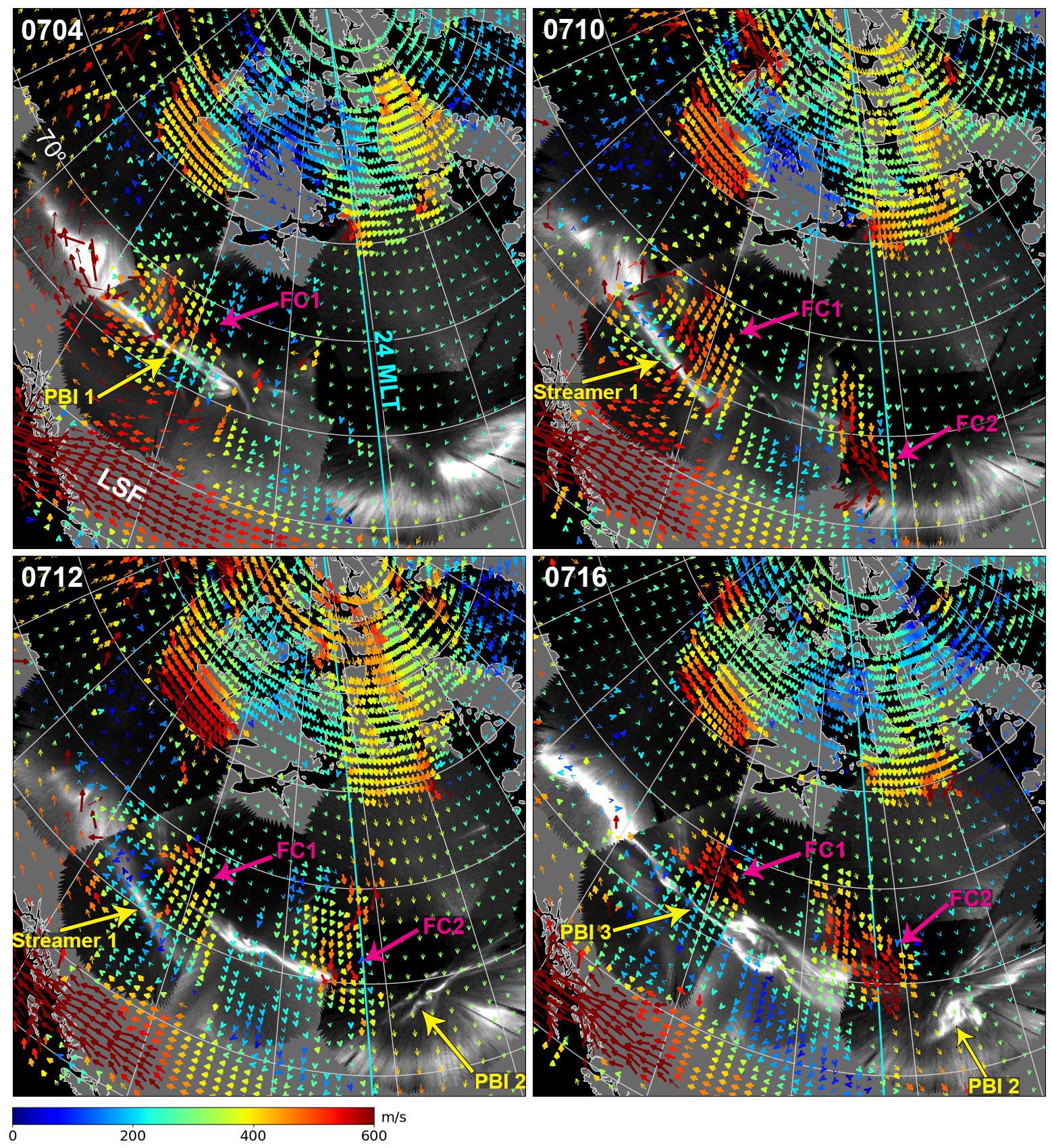
| Figure 2. Snapshots of RANK, GILL, FSIM, FSMI, and INUV ASI (gray-scale) images with SuperDARN SECS vectors (colored arrows) overlaid showing the time sequence of the PBI event on 15 February 2023 in the same format as Figure 1. |
Figure 2 presents selected maps of SuperDARN and ASI observations during a storm-time PBI event. The event proceeds as follows: the first PBI (PBI 1) occurred along an equatorward flow channel (FC1) in the pre-midnight sector, which showed a similar clockwise flow shear as the previous event. PBI 1 then extended into a streamer, gradually moving towards the equatorward boundary. Simultaneously, an intense equatorward flow channel (FC2) appeared in the midnight sector, triggering a second PBI (PBI 2). This sequence indicates a close relationship between the number of PBIs and number of meso-scale flow channels. Relating this to their magnetospheric counterparts, this suggests multiple X-lines spread in the cross-tail direction, each one supported by its own inflow channel.
Conclusion
This study showed for the first time high-resolution two-dimensional flow characterizations around poleward boundary intensifications. Our results showed that ionospheric flow bursts preceded PBIs, suggesting reconnection driven by inflow. Our results also showed a close relationship between the two-dimensional flow dynamics and PBI morphology. Considering the PBI as an ionospheric manifestation of tail reconnection, these results suggest a close relationship between X-line dynamics and their inflow properties.
Biographical Note
Katherine Davidson is a Postdoctoral Associate in the Center for Space Physics at Boston University. Her research primarily focuses on magnetosphere-ionosphere coupling using ground based optical and radar data.
References
Davidson, K., Nishimura, Y., Lyons, L., Donovan, E., Angelopoulos, V., Nishitani, N. (2026). Observations of high-resolution two-dimensional ionospheric flow dynamics associated with poleward boundary intensifications. Geophysical Research Letters, 53, e2025GL120760. https://doi.org/10.1029/2025GL120760 Please send comments/suggestions to
Emmanuel Masongsong / emasongsong @ igpp.ucla.edu
Please send comments/suggestions to
Emmanuel Masongsong / emasongsong @ igpp.ucla.edu