

2026 THEMIS SCIENCE NUGGETS
Discovery of a Compression Layer During the 10 May 2024 Superstorm
Sheng Li and Gilbert Pi
Charles University, Czech Republic
Introduction
On 10 May 2024, a powerful eruption from the Sun reached Earth, triggering one of the strongest geomagnetic storms in decades. The storm produced spectacular auroras that were visible far beyond their usual range, reaching as far south as Mexico. Behind this display was an interplanetary coronal mass ejection (ICME), a giant cloud of magnetized plasma launched from the Sun.
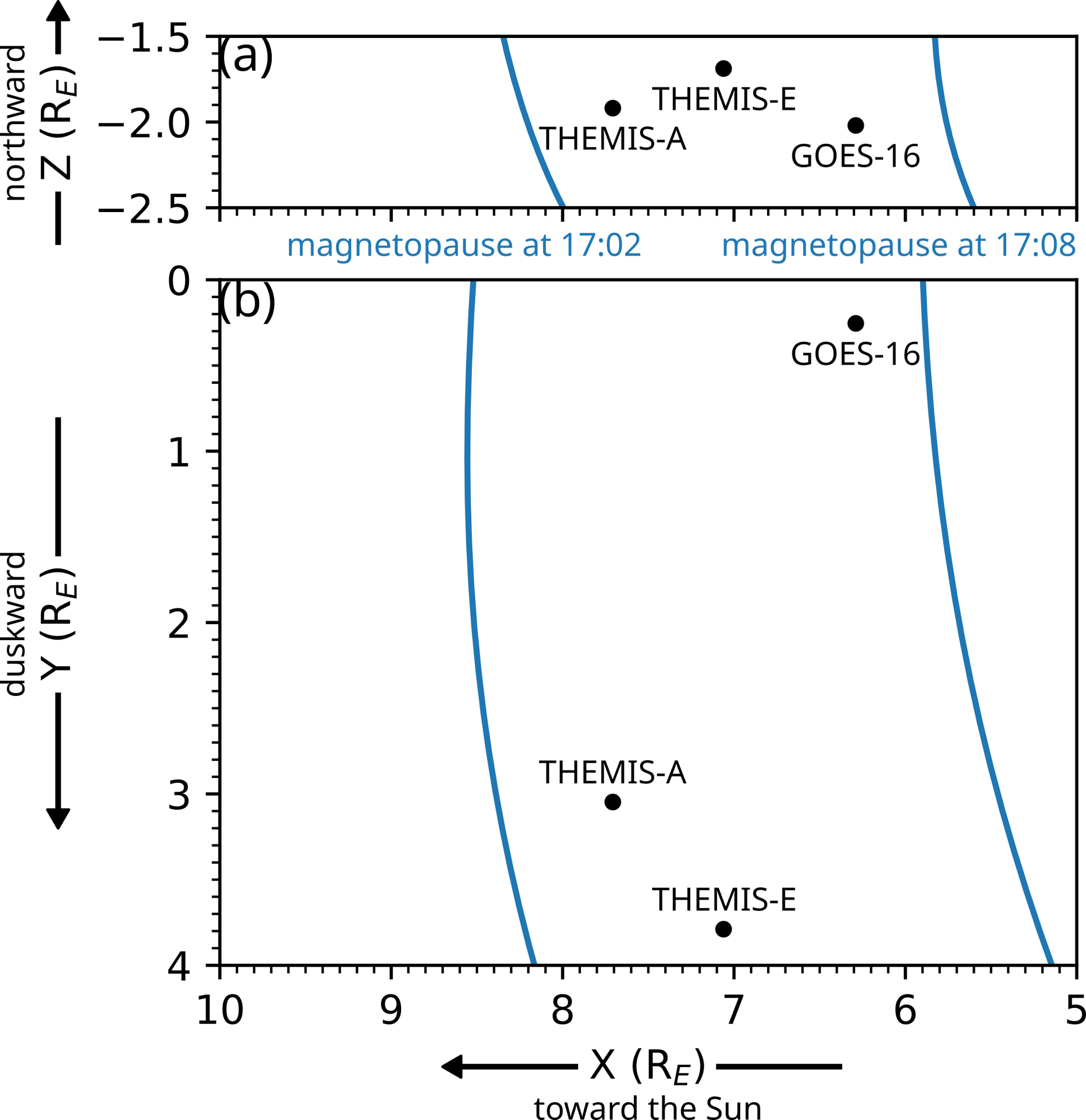
When the ICME reached Earth, it forced the magnetopause, which is the outer boundary of the magnetosphere, to move inward. By chance, three spacecraft, THEMIS-A, THEMIS-E, and GOES-16, were positioned almost along the Sun-Earth line (Figure 1). This rare alignment gave us an unusual opportunity to watch the compression process and to track how the magnetopause and the plasma surrounding it changed.
|
| Figure 1. Positions of THEMIS-A, THEMIS-E, and GOES-16 during the magnetopause compression on 10 May 2024. The blue curves indicate the simulated locations of the magnetopause at 17:02 and 17:08 UT. Panel (a) shows the X-Z plane, and panel (b) the X-Y plane. |
Results
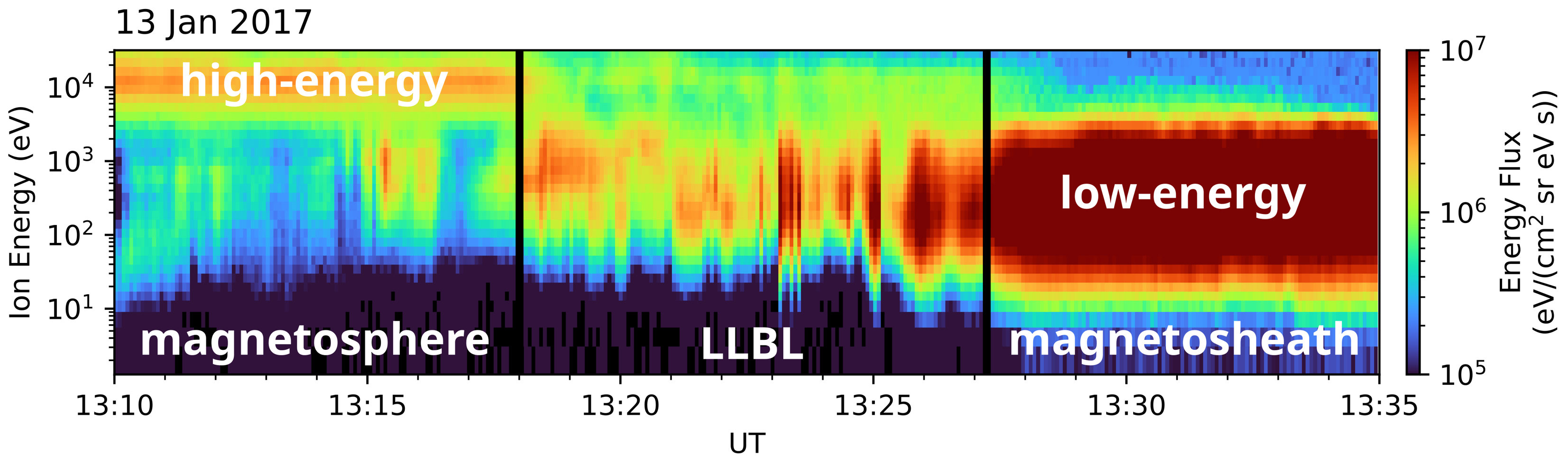
Near the magnetopause, scientists often observe a transition region where particles from Earth's magnetosphere (high-energy) and the surrounding solar wind plasma (low-energy) become mixed. This region, known as the low-latitude boundary layer (LLBL), typically contains particles spanning a broad energy range. We therefore expected to see a blended energy distribution during this event (Figure 2).
|
| Figure 2. Example of a typical LLBL. On the left side, high-energy magnetospheric ions dominate the energy spectrum. On the right side, low-energy magnetosheath ions become dominant. Between these two regions lies the LLBL, where particles from both populations coexist. |
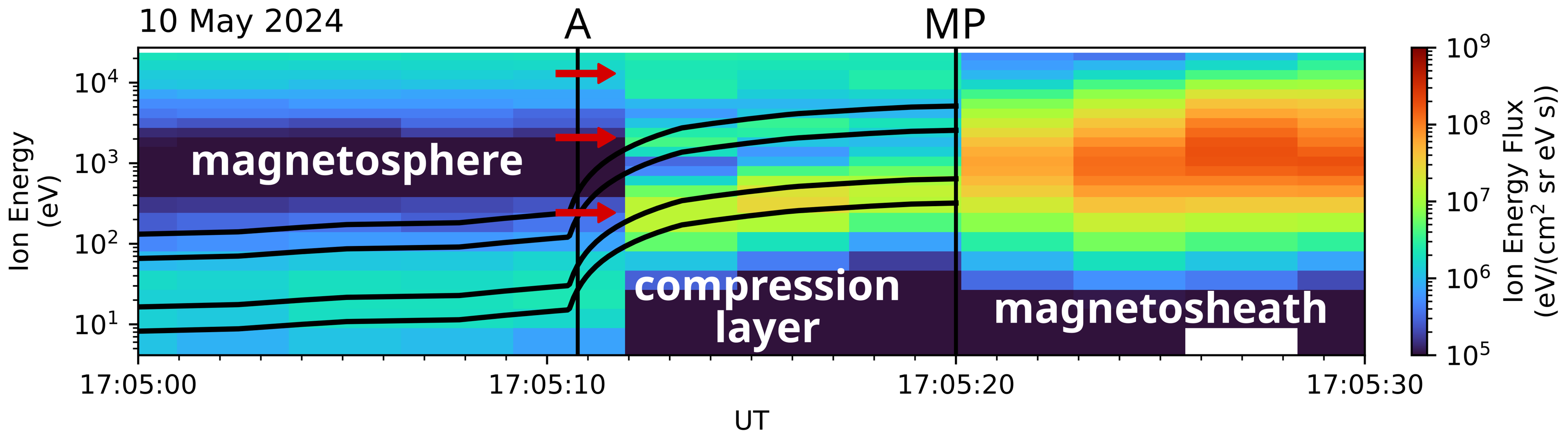
However, measurements in this event revealed a strikingly different picture. Rather than the blended distribution of particle energies expected in a typical LLBL, all three spacecraft observed three narrow and well-separated energy bands, indicated by red arrows in Figure 3 (THEMIS-A is shown as a representative example). Such a well-organized energy structure is rarely observed near the magnetopause, suggesting that something unusual was taking place.
|
| Figure 3. Ion energy flux spectra observed by THEMIS-A. Red arrows indicate three distinct energy bands. The black curves represent the calculated energies of ions moving with the measured plasma bulk velocity. From bottom to top, they correspond to protons, alpha particles, O2+ ions, and O+ ions. The region between boundary A and the magnetopause (MP) is identified as the compression layer. |
The key to solving the puzzle came from the way the instrument measures particles. Rather than directly identifying ion species, it records ion energy per unit charge. As a result, ions with different mass-to-charge ratios can appear at different energy levels in the spectrum even when they are moving together at the same speed.
Using the particle bulk velocity measured by THEMIS-A, we calculated the expected energies of several common ion species, including protons, alpha particles, and oxygen ions. The predicted energies closely matched the three observed bands. What initially appeared to be a puzzling pattern, very different from a typical LLBL, turned out to be a natural consequence of different ion species moving together within the compressed magnetic field.
These observations revealed a previously unrecognized structure immediately inside the magnetopause, which we call the compression layer. One possible explanation is that the particles in the compression layer were transported outward from the inner magnetosphere. As the solar storm compressed the magnetosphere, particles were carried inward together with the compressed magnetic field, allowing the distinctive three-band signature to be observed by the three spacecraft.
Conclusion
The 10 May 2024 magnetic storm provided a rare opportunity to observe Earth's magnetosphere under some of the most extreme solar wind conditions of recent decades. By combining observations from THEMIS-A, THEMIS-E, and GOES-16, we tracked the inward motion of the magnetopause and identified a previously unrecognized compression layer immediately inside it. The distinctive three-band structure suggests that rapid magnetospheric compression can organize plasma in ways that differ from the conventional picture of the magnetopause boundary region. The event highlights how extreme space weather can reveal previously hidden features of Earth's near-space environment.
Biographical Note
Sheng Li is a PhD student, and Gilbert Pi is a researcher at Charles University, Czech Republic. Their research focuses on Earth's magnetosphere, solar wind-magnetosphere interactions, and space weather.
References
Li, S., Pi, G., Nemecek, Z., Safrankova, J., Leonard, T. W., Sun, Y.-Y. (2026). Evolution of magnetospheric boundary layers under the 10 May 2024 ICME impact. Geophysical Research Letters, 53, e2025GL121067. https://doi.org/10.1029/2025GL121067 Please send comments/suggestions to
Emmanuel Masongsong / emasongsong @ igpp.ucla.edu
Please send comments/suggestions to
Emmanuel Masongsong / emasongsong @ igpp.ucla.edu