

2026 THEMIS SCIENCE NUGGETS
High-Time-Resolution Observations of Plasma Convection in the Nightside High-Latitude Ionosphere
Toshi Nishimura
Boston University
Introduction
Plasma convection is one of the most fundamental quantities that characterize the state of the magnetosphere-ionosphere coupling system. Super Dual Auroral Radar Network (SuperDARN) convection maps are widely used to describe global convection. Traditionally, the SuperDARN radars provide a map of line-of-sight (LOS) velocity every minute or two, and produce two-dimensional convection maps every two minutes by fitting the LOS velocity with spherical harmonic functions (SHFs) and statistical models. However, this 1-2 minute resolution has been a major limitation for observing rapidly varying flow structures. Recently, a new SuperDARN radar mode, called the wide-beam mode, has been developed to obtain observations over an entire radar field-of-view (FOV) in 3.8 seconds. This significant improvement over the traditional 1-2 minute scan duration can potentially overcome existing observational barriers. The present study demonstrates how taking advantage of this new observational capability, including using the recently introduced divergence-free approach for obtaining two-dimensional maps of full horizontal flow vectors, can shed new light on magnetosphere-ionosphere coupling processes.
|
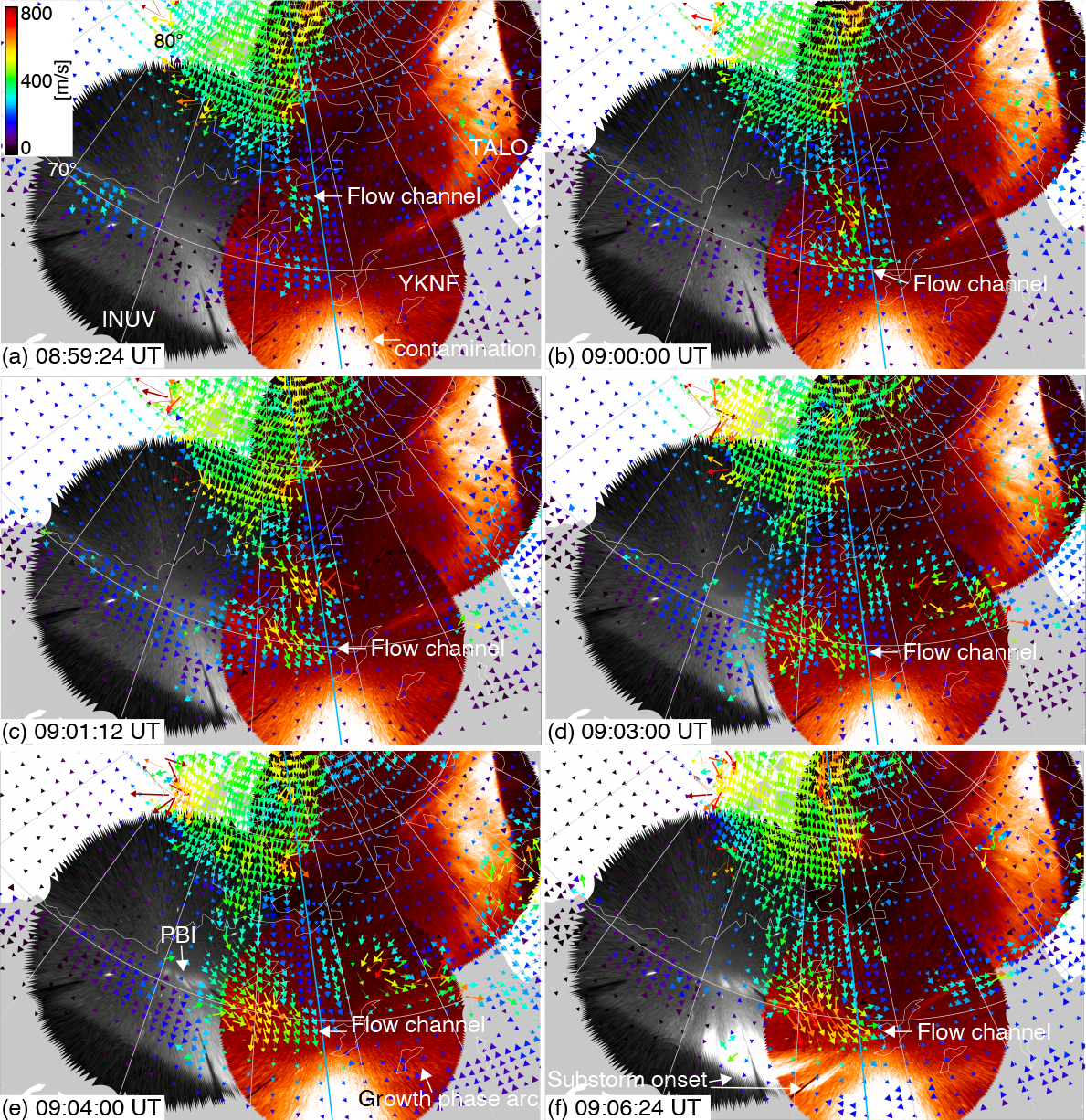
| Figure 1. Selected images of the SECS flow vectors superimposed on the THEMIS ASI data for the January 10, 2024 event during the growth phase and substorm onset. The thick and thin vectors correspond to the grid points with and without LOS measurements. The magnetic midnight meridian is marked with a blue line. The TREx red-channel and REGO red-line ASI data are shown with a red color scale. |
Results
Figure 1 presents selected maps of SuperDARN and all-sky imager (ASI) observations during a substorm. The SuperDARN velocities clearly show an equatorward velocity enhancement in the polar cap and across the oval poleward boundary, beginning five minutes before the substorm auroral onset. The equatorward velocity rapidly dropped around 69 degrees MLAT, but a weak velocity enhancement extended down to the growth phase arc. The enhanced flow was associated with faint poleward boundary intensifications (PBIs), although the ASI data did not show any indication of a pre-onset auroral streamer. Optically, this event does not have a precursor, and such events have traditionally been considered spontaneous substorm onsets. However, the flow observations show that pre-onset flows can exist even without a pre-onset streamer. It is likely that the flow shear along the duskward side of the pre-onset flow enhancement was not sufficiently strong to produce precipitation intense enough to yield a detectable auroral signature.
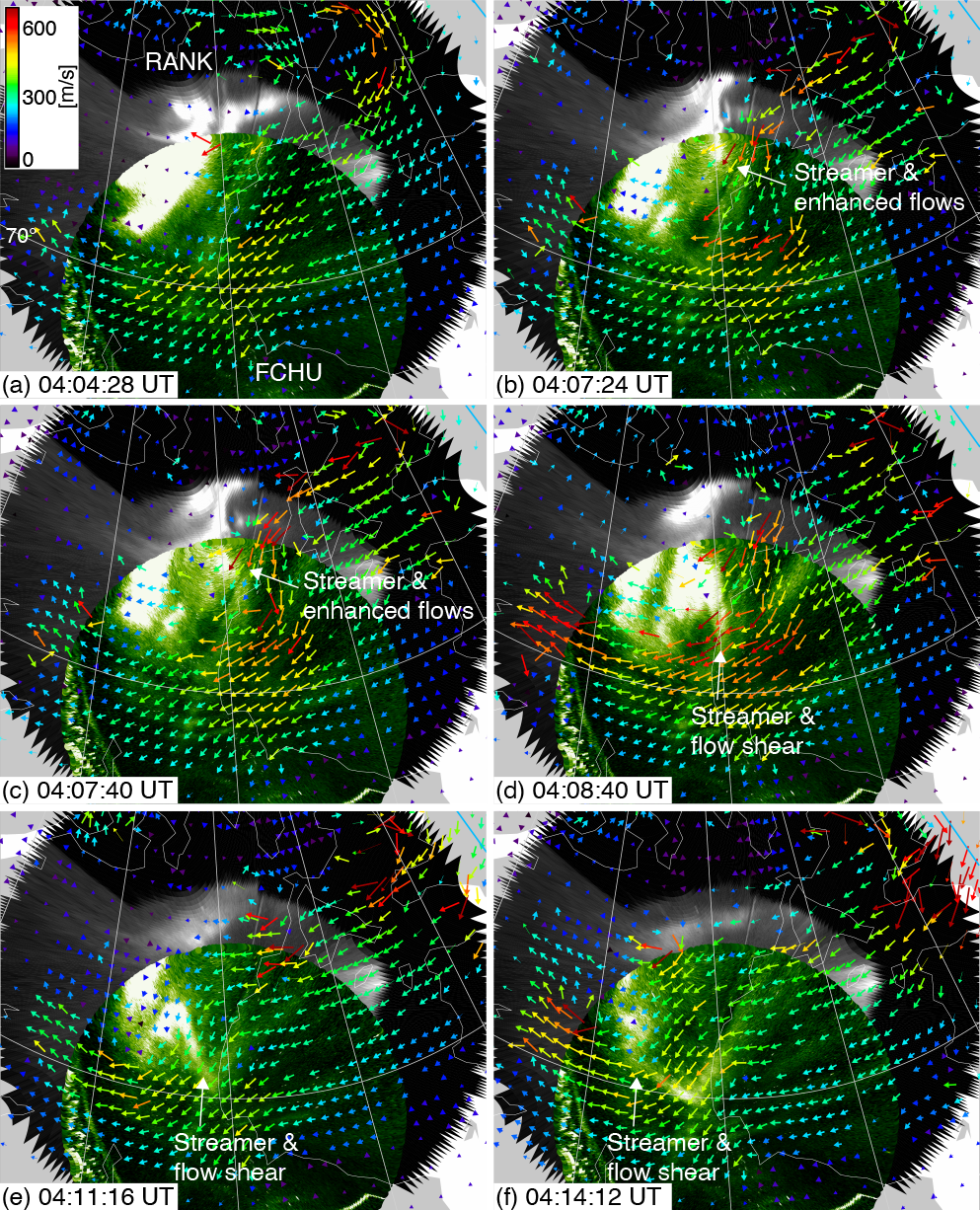
Figure 2 shows selected maps of SuperDARN and ASI observations during a quasi-steady southward IMF. The ASI shows repetitive auroral intensifications (PBIs). The polar cap flows also showed multiple enhancements, forming a clockwise flow shear around the PBIs. An auroral streamer moved equatorward and westward. An equatorward flow channel formed to the east of the streamer, and the region of the strongest flow velocity moved equatorward in association with the equatorward streamer motion. The equatorward flow reached further equatorward than the auroral streamer, indicating that the flow observations identify the equatorward extent of plasma transport more accurately. The flow channel turned westward, and the clockwise shear moved westward with the streamer. While it has previously been difficult to observe temporal variations of flow channels associated with auroral streamers, these high-time-resolution observations allowed us to visualize the dynamic evolution of the flow channel and its association with the streamer.
|
| Figure 2. Same as Figure 1 but for the January 23, 2025 event. The citizen-science ASI green channel data are shown with a green color scale. |
Conclusion
This study demonstrates how the new wide-beam mode of the SuperDARN radars, which obtains observations over an entire radar FOV in 3.8 seconds, together with the divergence-free data analysis approach, has the potential to provide important new insights into magnetosphere-ionosphere coupling processes. In addition to the flows during substorms and quasi-steady southward IMF, the paper also reported instantaneous convection responses during IMF southward turning, and ULF waves.
This study highlights that high-time-resolution LOS observations and the divergence-free approach are critical for an accurate understanding of plasma convection. The study shows the advantages of this new approach over the traditional SHF method at 2-minute resolution, which significantly underestimated the velocity structures and evolution mentioned above.
Biographical Note
Toshi Nishimura is an Associate Professor in the Department of Astronomy and Center for Space Physics at Boston University. His research interests include magnetosphere-ionosphere coupling using satellite and ground-based instruments, particularly all-sky imagers and radars.
References
Nishimura, Y., Lyons, L. R., Billett, D. D., Ponomarenko, P. V., Rohel, R. A., Ledvina, V. E., et al. (2026). High-time-resolution observations of plasma convection in the nightside high-latitude ionosphere. Journal of Geophysical Research: Space Physics, 131, e2025JA034804. https://doi.org/10.1029/2025JA034804 Please send comments/suggestions to
Emmanuel Masongsong / emasongsong @ igpp.ucla.edu
Please send comments/suggestions to
Emmanuel Masongsong / emasongsong @ igpp.ucla.edu