

2026 THEMIS SCIENCE NUGGETS
Evidence for Alfvén waves powering auroral arc via a static electric potential drop
Sheng Tian
UCLA Atmospheric and Oceanic Sciences
Introduction
Natural light displays known as the aurora provide a captivating glimpse into the electromagnetic dynamics in space plasmas. Aurorae are not exclusive to Earth but also observed on celestial bodies including planets and even comets. Previous studies have unveiled two fundamental auroral acceleration mechanisms: electric potential and Alfvénic acceleration. However, the relation of the energy processes associated with the auroral acceleration region has remained unclear mainly due to the lack of quantitative analysis. Employing quantitative assessment of energy budget using multi-platforms from the magnetosphere to auroral ionosphere, our findings underscore the interplay between these two mechanisms. Here we show that energy carried by Alfvén waves travels from the magnetosphere to the auroral acceleration region, forming an electric potential drop that accelerates particles to produce aurorae. Similarities in auroral particle behaviors between Earth and Jupiter suggest the applicability of the terrestrial scenario to Jupiter and potentially other celestial bodies in the Universe.
|
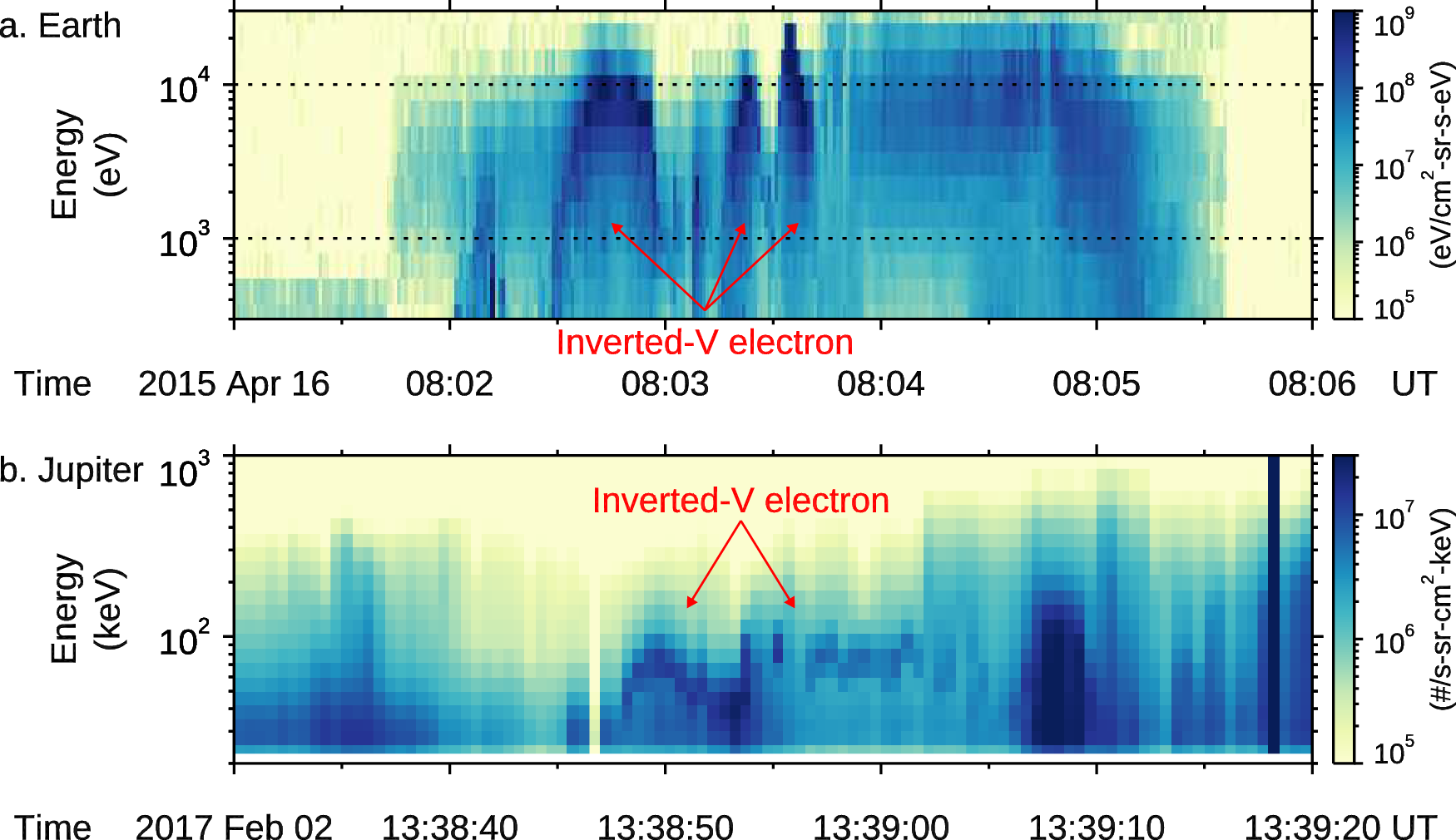
| Figure 1. Electron spectra produced by potential drop accelerations at (a) Earth and (b) Jupiter. The terrestrial observation was from the SSJ instrument onboard the Defense Meteorological Satellite Program (DMSP) F19 spacecraft. The Jovian observation was from the JEDI instrument onboard the Juno spacecraft, reproduced after Mauk et al. 2017. |
Results
Figure 1 shows the observations on inverted-V electrons on Earth and Jupiter. Inverted-V electrons are believed to be the smoking-gun evidence for the existence of a quasi-static potential drop. They have been observed on Earth and are well-known to be one-to-one correlated to auroral arcs. The fact that they are also observed on Jupiter suggest that what we have learned on Earth about auroral arcs is probably applicable to Jupiter and other planets.
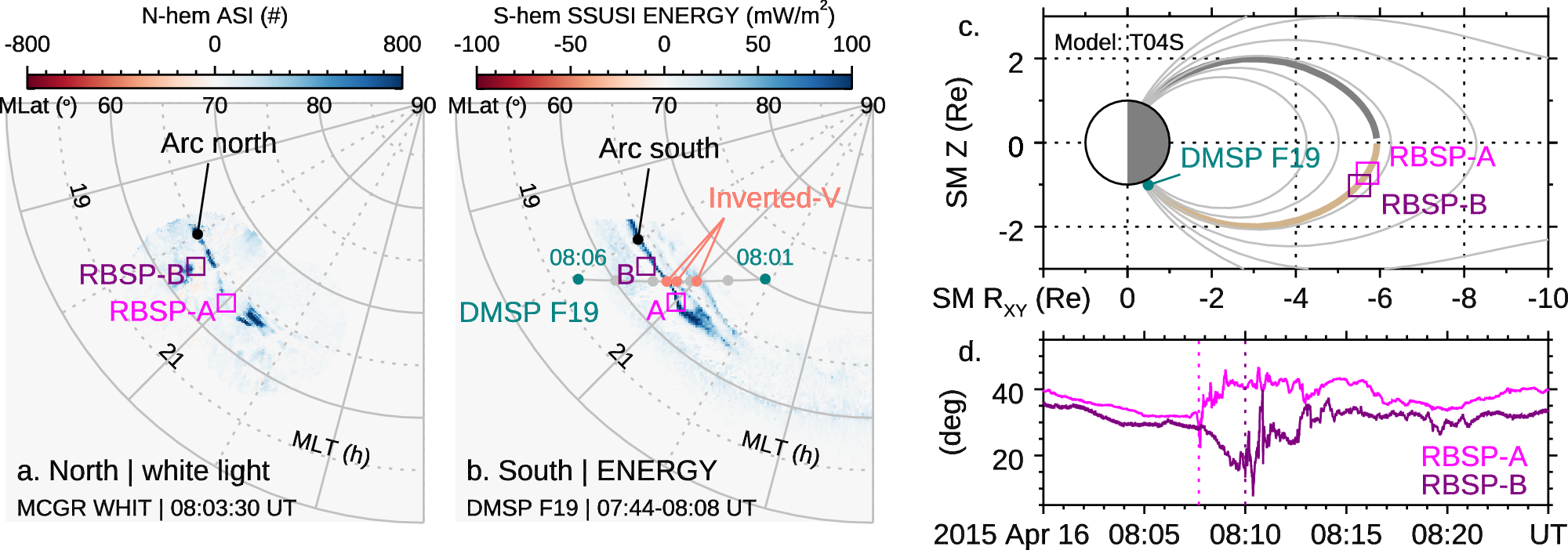
To improve our understanding of the auroral physics, we focus on finding a favorable multi-platform configuration when ground and in-situ observation align along the same magnetic field line at all key altitudes. Figure 2 shows such a fortunitous event, in which we have conjugate auroral observations showing an auroral arcs in both hemispheres and in-situ observations below and above the auroral acceleration region (AAR). Below the AAR, we observed inverted-V electrons in 1-10 keV, suggesting the existence of a quasi-static potential drop associated with the observed auroral arc. Above the AAR, we observed dipolarizations develop in magnetic local time, associated with the azimuthal development of the arc.
|
| Figure 2. (a) The auroral image taken by THEMIS ASI (white light, raw count) in the northern hemisphere. The image is presented in the plane of magnetic latitude (MLat) in degree and magnetic local time (MLT) in hour (h). (b) The auroral image taken by DMSP F19 SSUSI (UV emission, calibrated to energy flux) in the southern hemisphere. The footprints of RBSP-A and B are mapped using the T04 storm-time magnetic model. (c) The magnetic field lines connecting the magnetosphere and ionosphere. The locations of RBSP-A and -B and DMSP F19 are marked along the highlighted magnetic field line. (d) The elevation angle (θ = sin-1(Bz/|B|) of the magnetic field measured by the two RBSP satellites, showing strong perturbations when crossing the magnetic field lines threading the auroral arc. |
Further quantitative analysis on the observations above AAR shows that there are strong Alfven waves transmitting electromagnetic energy into the AAR. The high-alittude satellite also observed O+ ions beams from the ionosphere in 1-10 keV. Analysis of the dispersion of these O+ ions suggest that they are accelerated away from the ionosphere by the quasi-static potential drop which also produced the inverted-V electrons in 1-10 keV below AAR.
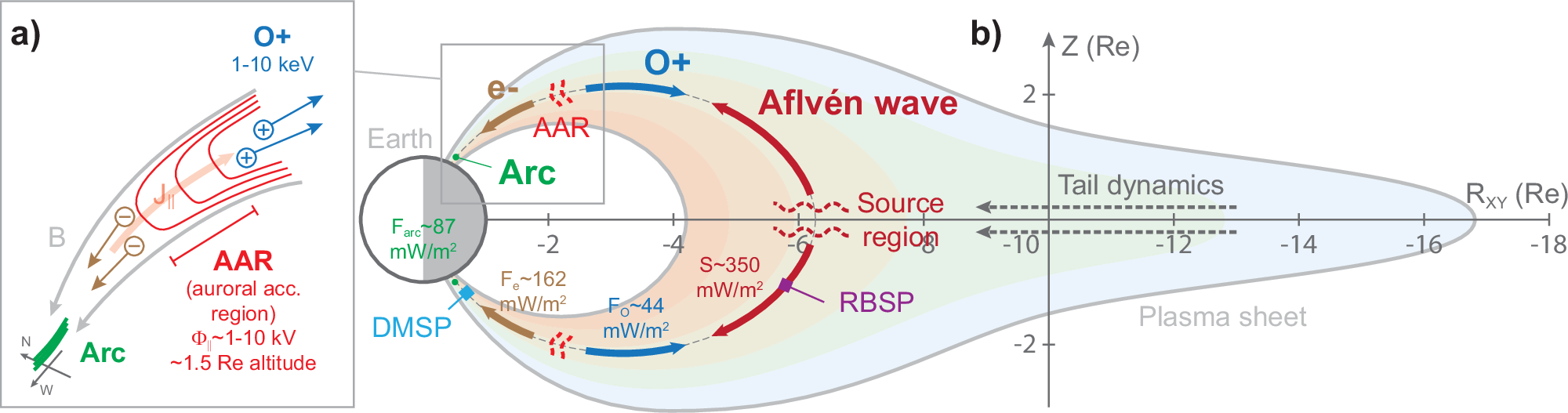
Figure 3 shows the energy budget derived from the above observations. The energy budget shows that the Alfven wave provides the electromagnetic energy as the energy source. This energy is consumed to accelerate electrons toward the ionosphere and O+ ions away from the ionosphere, by the quasi-static potential drop within AAR. The accelerated electrons, i.e., the inverted-V electrons, deposit their kinetic energy into the ionosphere, exit atoms to excited states. These atoms eventually return to the ground state and emit photons that are seen as the auroral arc.
|
| Figure 3. (a) Details of the auroral acceleration region (AAR) inferred from observations with the well-known behavior of the associated upward parallel electrical current (J||) and charged particles. Electrons are accelerated toward the ionosphere, producing discrete arcs. O+ ions are accelerated away from the Earth. Our electron and ion observations suggest that the parallel potential drop of the AAR was 1–10 kV and around 1.5 RE above the ionosphere. (b) Summarization of the energy fluxes along the magnetic field lines of the AAR, the nominal values of these energy fluxes, and other relevant processes. The detailed analysis of the energy budget is shown in Tian et al., 2026. The energy fluxes obtained from our observations suggest that the Alfvén waves, presumably generated by dynamical processes in the magnetotail, power the discrete arc via the electron and ion acceleration within the AAR. |
Conclusion
Using a fortuitous set of coincident observing platforms measuring different facets of the Earth auroral event on April 16, 2015, we provide strong evidence that the electromagnetic energy of the Alfvén waves powers the Earth’s auroral arc through a static potential drop that converts this energy to kinetic energy of inverted-V electrons and O+ ion outflows. Our findings underscore the interplay between the Alfvén waves and the potential drop and provide a comprehensive view of how auroral arcs form on Earth and potentially other planets and astrophysical objects.
Biographical Note
Sheng Tian is an Assistant Researcher in the Department of Atmospheric and Oceanic Sciences at UCLA. His research focuses on the auroral physics related ionospheric and magnetospheric processes and space weather applications.
References
Tian, S., Yao, Z., Wygant, J. R., Lysak, R. L., Bortnik, J., Lyons, L. R., Liang, J., Shi, R., Ferradas, C. P., Shen, Y., Reeves, G. D. (2026). Evidence for Alfvén waves powering auroral arc via a static electric potential drop. Nature Communications 2025 17:1, 17(1), 297-. https://doi.org/10.1038/s41467-025-65819-4Mauk, B., Haggerty, D., Paranicas, C. et al. Discrete and broadband electron acceleration in Jupiter’s powerful aurora. Nature 549, 66–69 (2017). https://doi.org/10.1038/nature23648
 Please send comments/suggestions to
Emmanuel Masongsong / emasongsong @ igpp.ucla.edu
Please send comments/suggestions to
Emmanuel Masongsong / emasongsong @ igpp.ucla.edu